Yo, dudes and dudettes! Let me tell you about a totally radical franchise that touched just about every form of media and product in my childhood!
Okay, real talk; you probably have already heard of Teenage Mutant Ninja Turtles. I'd be surprised if anyone ever to have been a child since their debut has not heard of them, and adults who are parents of such children are also likely to have heard of them. However, there is probably no time before or since the height of their first animated series that these turtles were so popular and so ubiquitous, and it's kind of ironic in retrospect, because that show...had issues.
Make no mistake; it was very creative, the sitcom-like dynamic between not only its heroes but (especially) its villains was both funny and very unique among cartoons, and its seemingly endless well of absurd story premises worked well to deliver on the random madness the title "Teenage Mutant Ninja Turtles" seemed to tease, but the show usually couldn't deliver well on the "ninja" part of its premise. TMNT actually began life as an indie graphic novel, aiming older and thus unafraid to get violent and bloody, and the Murakami Wolf Swenson company couldn't exactly translate that into an acceptable children's show in the conservative 1980s and achieve anything beyond surface-level accuracy to the source material. Naturally, many children then were totally unaware of that source material, so accuracy was a non-issue for them, but even children inevitably noticed that these ostensible ninjas who carried around melee weapons very rarely used them in that first cartoon; instead usually "fighting" their enemies with a bunch of slapstick and prop comedy.
So why did we forgive it so much? Why did we still love these turtles? I think it's because, while the 1987 show had become central to the brand's image, it wasn't alone. Early on, we got action figures, tie-in books, and tie-in graphic novels (known as Teenage Mutant Ninja Turtles Adventures and published by Archie) to help satiate our desire for a tougher and more adventure-oriented take on the turtles, but even beyond all of that, we could experience the martial arts skills of these turtles on full display in the realm of video games. Konami would create and continually refine an iconic style of beat-em-up gameplay for the brand, and its games from that era are still remembered fondly.
However, TMNT's popularity waned in the second half of the 1990s, and though it would see several rebirths on TV, at least some of them good, the games made based on those newer incarnations never fully translated the feeling of the older games to 3D. (There is a lot to analyze about why, and I might do it in a future blog entry.) But with the recent resurgence in popularity that side-scrolling, semi-3D beat-em-ups have experienced, Dotemu and Tribute Games have returned both to the world of the 1987 TMNT cartoon and the style of video games made based on it, and the result is simultaneously an accurate throwback in all of the ways that count, and a commendable upgrade in the ways more modern gamers would like. It's scenario, meanwhile, is a pretty underwhelming one, but I'm definitely left wanting more rather than less.
At a Glance
Similar to many other retro-styled games released recently, TMNTSR goes for 2D(ish) gameplay and surreal, pixel-based graphics, while also taking good advantage of modern technology to do what the games that inspired it never could have. In this game's case, that tends to mean bridging the (sometimes wide) gap between the classic Konami games and the cartoon they were based on.
Two of the first things you'll notice carrying over from the show are the Turtles' friends, Splinter and April. While they have been playable in TMNT games before, this is the first time they're playable in this sort of TMNT game, and their addition is welcome. It adds variety to the gameplay, but not so much you'll have to fight your own muscle memory when switching characters, and the increased attention to superb sprite work really helps bring all of the characters to life.
The relatively limitless color pallet has let its sprite graphics resemble the cartoon's art-style much more, with some famous clips of animation directly recreated in pixel form. Facial expressions are also a lot of fun to see here, although some people won't like how more contemporary "bean smile" expressions have gotten into the mix for some frames. Most amusingly, many of your enemies will pass the time in a variety of surprisingly unmenacing ways before engaging you in combat, a true flex of the modern ability to include all of the animations a character would normally need and then some.
I mentioned that one of cool things about the old video games is that compared to the cartoon, they let the turtles fight like the super ninja warriors they were. That is still true here, but just for a laugh, this game also includes moments where you can use items in your environment to conk some enemies out, akin to the slapstick you knew and probably didn't love from the cartoon. Don't worry; these aren't anywhere near common enough to undermine this as a fighting game, and except for completing some bonus mission objectives, you never have to use them.
The Konami TMNT games already had an impressive amount of voice acting for the time, and there is more of that here, though not much by modern standards. The original actors for the turtles are all back, also voicing those villains they doubled as in the show, and while none of the other actors returned, they don't have enough voice lines to make that a big deal. Besides, voice work in this game will inevitably be upstaged by its fantastic soundtrack.
Rock, dude!
Tee Lopes, his talent already well-established by Sonic Mania, Streets of Rage 4, and a very underrated remix of the River City Ransom theme, has returned to helm (most of) this game's soundtrack, and it's probably his greatest work yet. While you will likely notice a few of his signature tropes in places, most notably during a mall stage whose music sounds fairly reminiscent of Studiopolis from Sonic Mania (but that still makes it a great song), it doesn't stop him from incorporating loads of delightful influence from both the first Ninja Turtles cartoon and the Konami video games; mostly Turtles in Time. Early on you'll notice the Channel 6 News theme spin off into a fantastic horn-driven tune, a new song with the same swing beat as "Alleycat Blues", and a solo that almost certainly is intended to reference "Sewer Surfing". Oh yeah; there are solos in many of these songs, and the songs have a sufficient length that you won't tire of them. Despite how formidable Tee Lopes is on his own, he's also joined by a number of talented musicians, singers and rappers to take the soundtrack even further, incorporating the sort of cheesy but unforgettable early-90s hiphop that drove the first two live-action Ninja Turtles movies, and a rock song that could have come straight from the infamous Coming Out of Their Shells Tour. Unfortunately, for whatever reason the fun wanes a bit towards the end of the game, as when you leave New York to go to the villains' home turf, the music becomes more ambient and menacing, but it's worth soldiering through because after you beat the game, probably the most glorious TMNT rap song ever is waiting for you in the credits.
Back to the Grind
As much fun as this game is to see and hear, the story feels disappointingly thin.
Now, as stated in the first part of this review series, I understand that beat-em-ups don't tend to have very complex plots. However, Ninja Turtles as a brand is treasured for how its scenarios get outlandish, and the previous beat-em-ups followed suit. The first beat-em-up indeed had a fairly straightforward scenario, but the second involved Manhattan being cut out of the ground and levitated into the air, while the third involved Krang stealing the Statue of Liberty (presumably it's easy to do when you already have the technology to steal the whole city) and also the turtles time-traveling.
In this game, the Statue is once again stolen, but this time there is no time travel, and in fact, nothing much beyond a standard beat-em-up in a messy city. Most level tropes are ones you've already seen from the series. Despite the name, there isn't all that much Shredder in this game, and he doesn't seem to be getting much revenge. I figured a revenge would entail a scheme targeting the turtles directly, but instead, it's standard villain antics that heroes react to. Most of the game, your heroes are chasing Krang's goons as they bring him back his android body. (If that sentence didn't make sense to you, you haven't seen this show.) The cutscenes about this can be fun, but they're short, and it never feels like very much is ever at stake. There is a nice twist at the very end, but it still leaves this game feeling hollow compared to the past two. You also get unique ending screens for each character you beat the game with (that is, if it's Player One), but they, too, are underwhelming.
But again, this genre isn't really about deep plots; it's about fighting, and fortunately in that realm, this game easily outdoes any of its predecessors.
Let's Kick Shell!
People who have fond memories of the first arcade TMNT game are apt to say things like "Man; I had so much fun sinking quarters into that machine." To these people, let me be frank: If you enjoy the act of losing money, you might be masochists, and arcade games made purposefully shallow and unfair for the purpose of maximizing profits are not objectively commendable. Fortunately, Konami's TMNT games did not stay in that undesirable spot; they gradually gained depth, and Shredder's Revenge follows suit with more depth still.
At its base, though, this game maintains the gameplay recognizable from that overrated arcade game and its better sequels, meaning there is only one basic attack button. This, however, has a great deal of flexibility, as when you press the button, where you press the button, what else you're pressing when you press the button and how long you press the button all affect what attacks your character does. So while you can just mash the attack button and be sure that something will happen, there's a great deal more depth to doing this optimally. The above also applied to past TMNT games, but it's in the move options beyond that base that TMNTSR comes into its own.
Past games like this handled special attacks by pressing the attack and jump button at the same time, draining HP while doing them, and this game is quite different in that regard. You now have a dedicated special attack button, but instead of taxing your HP, it's limited to a small number of uses. Small, yes, but you can earn more uses by hitting enemies enough times without them (or anything else dangerous) hitting you in the process. Or if that's too hard, you can also taunt to earn one special attack use, provided you don't get hit during that taunt motion. Most of this special attack system is well-balanced but that last part does feel overpowered once you learn that you can also taunt in those periods when there are no enemies onscreen and the game is prompting you to go forward to where there are more. It breaks the pace, though not much, and it can get annoying to hear April asking "Any comments?" to the air multiple times in succession.
Still, the special attacks themselves are great to have. Most are some form of "area of effect" blast, but there's still enough variety between them--with your current character adding more variety still--that their presence adds depth. The best way to sum them up is that their mere presence makes things easier, but it'll take skill with them to make things much easier. They also add personality to the fight, as every character has several
of their own, complete with unique animations and voice clips.
Easily the most important addition to this game is the dodge button. This allows characters to flip backwards quickly, or forwards quickly if you press in that direction, and characters are also momentarily invincible while doing it. It's likely that most of the "skill ceiling" of this game entails mastering that dodge mechanic, as ultimately this sort of game is about draining your opponents' HP before they can do the same to you, and to test just how good you've gotten at that mechanic, there's an Arcade mode that challenges you to through the whole game without losing all of your lives. With as simple as the move itself is to do, it does sometimes seem like most of the depth to using it correctly is in memorizing when to press the button for every moment of the game, and so I can see many people finding that annoying. But the dodge in itself is still a lot of fun, so I'm glad it's there. It seems to fit ninjas a lot better than a simple block would, and keeps fights from degenerating too much into crass button-mashing to brute-force through.
You Were Expecting, Maybe, The Adams Family?
All of the above innovations to the gameplay definitely help breathe new life into a beloved old experience, but boss battles feel like kind of an afterthought. The handful of TMNT beat-em-ups that inspired this one were in themselves known for repeating bosses from game-to-game, although their patterns did vary somewhat between them. This game, rather than taking advantage of our heightened technology to surprise players with interesting new twists on the concept of a TMNT boss, instead seems intent on upholding that tradition, as if going down a checklist of the rogues gallery we've (mostly) seen before, complete with very similar moves and tactics on some of them.
To be fair, there does exist some reason to do this in the current context; we've had a long break from this sort of TMNT beat-em-up and this universe in TMNT beat-em-ups, so perhaps it's considered an obligation to bring back as many things from them as possible. I can definitely understand why some nostalgic players would feel slighted if their old favorites weren't in this game. But compared to games like Sonic Mania and River City Girls--and inevitably, this game will be compared to those games--this game's bosses lack the creativity to truly wow returning players. The game also doesn't really have enough plot or voice acting to make these bosses appealing for who they are. There's a fun running joke about how after the Foot Clan takes over Channel 6 news, Bebop has a blast making a bunch of shows starring himself, but no other character is anywhere close to as fleshed out.
I can't help but wonder if part of the reason this game's design is a bit too conservative in spots is because of how much more poorly-received TMNT games were that have dared to be anything besides this sort of old-fashioned beat-em-ups. Having not played many of those other TMNT games, I cannot weigh in on that. But it's a shame, even so.
Closing Thoughts
Of the games I've played for the Summer of Beat-Em-Ups so far, I'm pleased to say this one is the least flawed. It looks, plays, and sounds great, and manages to feel a lot like beloved old games without reviving many of their flaws. Having seen just about everything this game has to offer by now--much of it many times over--I'm definitely ready to call this the best TMNT beat-em-up ever made. In fact, it's so good that it might be genuinely hard to go back and play the games that inspired it. Perhaps Konami should have released The Cowabunga Collection before this game!
However, should we really be so impressed that a game made now is so much better than ones made several decades ago? There's actually no reason to suspect that wouldn't be the case, given the increased technology and hindsight. Given that potential, I'm almost more tempted to resent that this game isn't evenbetter than it already is, and while it's not fair to demand depth from a beat-em-up plot, I think that from this series, it's reasonable to expect more scope. I still hope that before this resurgence of beat-em-up popularity burns
out, we get another TMNT game that plays like this and is set in this
universe, but also commits to telling a new story with more new
characters and new locations. After that, I might even accept a bit more experimentation with gameplay.
But meanwhile, you should still totally buy this one, dudes and dudettes!
In the early 1990s, as the Nintendo Entertainment System was on its way out to make way for 16-bit gaming, a game called River City Ransom came out for that dying console. It wasn't a big hit at the time, but subsequently it became a cult classic. And why not? The game's unique mix of beat-em-up and RPG elements meant that there was no other game like it...or so people outside of Japan thought. That all changed with the release of River City Tokyo Rumble, which we covered last time. But the series hadn't been all that able to capitalize on the original game's cult status to become an even bigger sensation, and I think part of the issue was that making any more beat-em-up/RPG hybrids diluted the uniqueness that had been River City's hallmark. With no one game in the series being able to rely on that uniqueness anymore, something else had to be done to surpass expectations and make newer entries a success, and ARC chose to go in deeper with the RPG side of the formula. As I said last time, though, it's tricky to get that right without bogging things down more than it's worth, and unfortunately River City Knights of Justice bogs down, hard.
At a Glance
The most immediately obvious sign that this game is going in deep with the RPG stuff is its setting. While (most of) the character sprites are still the blocky, chibi things we know from Super Dodgeball and River City Ransom, they've left the modern urban setting behind in favor of a generic fairy tale world, the likes of which most RPGs inhabit. As you trek across this medieval Europe-inspired world, you'll fight your fair share of humans but also ogres, ghosts, some rather unmenacing blobs and even the occasional dragon. You can still punch, kick and grapple, but you also get to equip a lot of swords, magical staves, potions and other fantasy RPG tropes, which have a variety of effects.
Welcome to River City--I Mean, Riverandia
We've moved the plot from a city to a whole country. Actually, maybe several countries, depending on how you define them. This being a generic fairy tale world somewhat modeled on medieval Europe, they're arguably fiefdoms.
Interestingly enough, unlike the other ARC-developed River City games, this one has been localized using character names that are based on the western localization of River City Ransom, but more...formal, maybe? So Kunio is now Alexander, Riki is now Reinhold, Hasebe is now Roxanas, etc. It's a strange choice, but maybe one that makes some sense in that this sort of fantasy is, again, loosely based on medieval Europe. Japanese-sounding names would detract from that fantasy, so I'm fine with the change.
However, this is not an overall well-written fantasy. It's toned down the bratty attitude that bugged me in last game I reviewed, and there's the occasional funny line, but much of the dialogue you read is strictly functional at best and a bunch of small-talk from bystanders at worst. To be fair, it's not like this isn't true of many medieval fantasy RPGs, but it'd be nice if this frequently silly series gave us better.
Either way, the expanded (maybe?) scope has changed how you navigate the world, and it takes some getting used to. You get what looks like a world map to choose your destination, some being towns, others dungeons, and some random spots of the countryside you can choose to visit. You might suspect this works akin to such maps in games like Super Mario Bros 3, Super Mario World, and Donkey Kong Country, with your character being the moving cursor that selects your destination and enters. This isn't so, however. Instead, after you select a destination, Alexander must move there from his current location, and he can get jumped on the way in potentially hostile areas of the map. This triggers fights in those locations, as if you'd gone in intentionally. Fortunately, you can flee the area and continue on your trip, and you can also stop your trip by pressing B. So don't make the same mistake I initially did with this game; don't try to get anywhere more than a few spaces away in one stretch--at least not until you've leveled your character up a lot. Speaking of which...
Lots and Lots of Loot
...except not really. While in many regards this game ups the RPG components, there's actually no leveling up this time around. Nor does food consumed in restaurants increase stats. Instead, this game's designers got way too enthusiastic about their new inventory system and decided to tie a lot of game mechanics to it, stats included. To power up your character, you obtain and equip items. There's a slot for gloves, a slot for shoes, (both of which increase your stats) and ten slots collectively dedicated to scrolls, rings and charms. Including scrolls lets you do special moves (one per-scroll), while rings and charms increase stats like the gloves and shoes. You can also boost your stats further with gems, which have the advantage of not taking up any slot, but are harder to get.
Then there is everything else...a lot of it. You'll visit lots of towns in this game, wherein you can buy many objects, and some are useful, such as potions, but others are as mundane as literal cardboard boxes, whose main purpose is to be used as macguffins in fetch-quests. There are also restaurants where you can go eat a wide variety of suitably medieval things (Monster Meat being my favorite) to restore hit points, mana points, or both, but it's actually all pointless because the towns also have inns that completely refill both, and cost less. I think this has to be an oversight on the developer's part; perhaps they didn't spend enough time analyzing every option, or perhaps they originally intended for these restaurant items to increase stats, only to leave them pointless as equipable items took over that role, but either way, their immediate obsolescence definitely lessens the narrative fun that this world should have. But worse is that a similar lack of planning also affects this game's vast arsenal of weapons, because when you get into battle, the game is unfortunately at its very clumsiest.
En Garde! Oops, I Slipped; Hold Up!
Right off the bat--no, make that club--there's one big inherent problem with making a River City game that's so heavily focused on the use of weapons, and that problem is that frankly, weapon use in this series has always kind of sucked. The moment you pick up a weapon in most River City games, the punch button that formerly could do a wide variety of attacks depending on context gets taken up with just one style of simply bonking foes with that unblockable and often unbreakable stick/pole/whatever, while kicks are also disabled as the kick button is used to throw the weapon. To be fair, some of the games do attempt to make the use of weapons a bit more nuanced with special moves that utilize them, and this is one of those games. Among others, you can get a scroll to do an attack where you jump into the air with a sword and slice through a whole bunch of enemies, and that's fun and cool. But it's still essentially a castle in quicksand, as basic melee weapon combat remains a clunky ordeal of both you and your allies mashing the punch button to bonk each other while neither of you can block the other. Yes; in an otherwise standard medieval fantasy world, where many people have swords and armor, nobody has ever thought of using a shield, nor turning a sword to block another sword.
There are magic weapons too, usually staffs. These can also bonk people like the melee weapons, but that isn't really the point; the point is to press the new "use" button to activate their special abilities. These abilities are often more powerful but consume mana, and in some cases, they can be pretty cool. Unfortunately, this combat is not all that well suited to them, either. Some magical abilities, such as becoming invisible or confusing your opponents, can be consistently useful, but as most of them rely on an "area of effect", they tend to be complicated by how everyone is constantly running around in this game and there isn't much aiming. You might shoot a bunch of fireballs only to miss enemies that move north or south out of the way, move north or south after them to line up another shot, and hope they don't move out of the way again. Despite that, the most frequently useless item I have found is the healing staff. It spawns magical circles on the ground, which can heal you and your teammates, but because they, like your enemies, almost never stand still, good luck getting them to stand in them long enough to heal. You can switch which of your team mates you control, but it's more awkward than anything else, as it tends to result in an abrupt shift around the screen during chaotic battles. (We'll come back to this mechanic, and with a vengeance.)
To make this already highly randomized mess more annoying, characters frequently drop their weapons. All of the weapons have two stats (plus some, mostly the magic ones, having special abilities), related to how much damage they do and how easy they are to hold onto. And with everyone tramping back and forth across the battlefield after each other, a dropped weapon is often less than a second away from being picked up by an opponent. Soon after battles end, the scene fades and you go back to the "level select" screen, meaning you might very well not retain a weapon you brought to the fight, so don't get too attached to it. (Incidentally, this fade out is also problematic because it prevents you from picking up all of the money your opponents drop.) Conversely, you have the ability to jack opponents' weapons and add them to your inventory, so it's possible you're better off not even bothering to buy weapons in stores. This is a good time to transition to the game's inventory system, which is also bad.
That Deserves Repeating: This Game's Inventory System is Really Bad
To go with this game's increased focus on weapons, it allows you to build up a huge inventory of them, as well as some other items like food and potions. From this you can create a mini-inventory of "favorites", which you can select on the fly during battle. It sounds convenient on paper, but in practice it's anything but.
Last review, I complained about how the ability to pause and consume healing items lets you cheese your way through the longer fights, and that with how absurdly much HP some bosses had, that was essentially the only viable solution. This game's designers seemed to share my complaint but swung way too far in the opposite direction. Now the favorites menu is the only thing that you can select items from during battles, meaning no stopping time to consume a bunch of healing items at once, and to be fair, this time none of the bosses are so inflated that I couldn't beat them without that cheat.
Unfortunately, the real-time selection is cumbersome, especially in the thick of battle. The only form of selection you get is one shoulder button to cycle left-to-right through the list, looping to the start when you pass the end. Is the item you need too far to the right to access it immediately? Tough, you just need to cycle through and hope it'll still be needed when you get there...assuming your character is still conscious, of course Did you cycle through too fast and pass the item you needed? Tough, you don't get a button to cycle leftwards because the other shoulder button is used to switch party members.
Now, that might be a reasonable sacrifice in many RPGs. In many RPGs, your party members tend to have very different, and mutually exclusive abilities, so switching between them may well be necessary to finish battles. But in this game, while different party members may play as different RPG archetypes like paladins and wizards, beneath it all a character's abilities are defined by what items that character has. Because HP and mana stats are determined by equipped gear, the special moves your character knows are determined by equipped scrolls, and most of the attacks you can do in any given battle are dictated by the items in that favorites menu, Alexander himself can just swap between serving any of those functions via that menu. So given there isn't any good reason to switch which character you're controlling, it would have been better had they not included that ability and instead used the other shoulder button to cycle through the favorites menu in another direction.
Yet even if you could do so in two directions, cycling through a menu still isn't the ideal way to fast-select items, and that brings us to the most truly inexcusable thing about this inventory system. Despite that this is a 3DS game and that the favorites menu is on the lower screen, there is no touch-select functionality! While the menu we got is really too small to work with anything but a stylus and it's not convenient to use a stylus and buttons at the same time, because the favorites menu is the only part of the inventory system you can actually use during battle, they could have omitted the rest and enlarged the slots on the favorites menu, making it easy to press with one's fingers. How nobody thought to do this sort of thing when it is not only a huge quality-of-life improvement, but present in pretty much any other DS and 3DS game, is almost mind-boggling.
Closing Thoughts
Last time on Summer of Beat-Em-Ups, I concluded that River City Tokyo Rumble was serviceable, a follow-up to River City Ransom that played a lot like that game, for both better and worse, which stumbled over its attempts to have more plot but didn't become totally unpalatable as a result. Knights of Justice expands on the formula, but for every step forward there are many more steps back. It's not fair to say this game's combat is never fun, but there's scarcely any point when it doesn't feel unpleasantly messy. What's particularly sad is that this game's big problems are all tied to its expansion into more RPG-like territory, which in theory seemed like a good fit. It's possible to imagine a River City game that puts a greater emphasis on items, and is better for it...but this isn't that game. Instead, this game's items are poorly balanced and poorly implemented, and that actively detracts from the gameplay. You're better off playing the original River City Ransom or playing any number of other fantasy RPGs.
But look on the bright side: Next time on Summer of Beat-Em-Ups, things get good!
At this point, I have undoubtedly discussed the River City series more than any other on this blog. I've spent a lot of time waiting for River City Girls 2 to debut so I can enjoy it, criticize it, or most likely both, but that isn't the only thing 2022 has on offer. We also have known for a while that Teenage Mutant Ninja Turtles: Shredder's Revenge is coming this year, and in fact more recently I learned it will premiere this week. Meanwhile, because the 3DS eShop is circling the drain, I decided I might as well buy those River City games that actually got western releases, and play through them so I can maintain my proud position as a know-it-all who likes to lecture players who first learned of the series from River City Girls. Then recently, we also learned that River City Saga: Three Kingdoms is getting a release over here.
In other words, these months are quite overstocked with beat-em-ups I intend to play. Most from the River City series, but of course I can't say no to the Turtles. And given I'm going in so deep to this genre, I figured, why not blog about my experiences? So I'm doing that now. This series will feature reviews of beat-em-up games I played this summer, and we start it with River City: Tokyo Rumble.
At A Glance
The first of ARC's Kunio games to come west, Tokyo Rumble will feel mostly familiar to those who have played River City Ransom. A gang called the Lion Alliance is muscling in on Tokyo, so Kunio teams up with a few of his friends/rivals to defeat them. This means you can always have an AI-controlled ally tagging along and assisting you. You start with Riki but eventually Shinji and Misuzu also join, though only one can follow you at a time.
Welcome to River City (Or is it Tokyo?)
As is a proud tradition in River City games, this isn't your standard left-to-right scrolling beat-em-up; you can explore the city at your own pace and go where you choose, to an extent, but the set-up does have a twist that makes it a bit more confusing and restrictive. The city is divided into several districts, and often when you reach an end of one you'll just wrap around to its other end--or sometimes it's a dead-end. To get into any other districts, you'll need to take a train, and destinations only unlock after you defeat bosses--and the order you defeat them in is set in stone. Once you get this, the nearest train station is never hard to find, and a minimap does at least remind you what district you must visit to progress the plot. However, because you're not bopping your way through most of this game's terrain as a means of getting elsewhere, it can be hard to remember the layouts of the districts themselves, and this can be an issue when you revisit them.
Take in the Sights
I've been a pretty big critic of ARC's take on the Kunio series ever since they began making new entries on the 3DS, and this is because the graphics, I felt, were a big step in the wrong direction. The big offending issue is that canonically, Kunio is supposed to have brown-to-ginger hair, and Riki is supposed to have blue-to-purple hair. This has always been the case, but early 8-bit Kunio games had to simplify them to having just black hair. (8-bit sprites have substantial limits on how many colors they can use.) As soon as the 16-bit era rolled around, the in-game sprites started to represent their canon hair colors. This remained the case for the new/remade Kunio games that Million (who had the license at the time) released on the Game Boy Advance and DS, including the series' brief two-game stint in 3D, and it reached its peak in the gloriously colorful Kunio MMORPG, whose cancellation I still resent. But when ARC System Works took over the series, starting on the 3DS they reverted Kunio and Riki back to their 8-bit, black-haired sprites, while sticking them in a 3D environment that didn't match well. Also, while it would be one thing if ARC wanted to reboot the series so
Kunio and Riki just canonically had black hair, they did not; ARC's art
of the characters still depicts them as having more colorful hair, and
being more colorful in general. I was instantly turned off and wrote this off as an ill-advised attempt to follow in the footsteps of Mega Man 9 and 10.
Having now given this game a fair chance, it's better looking than I initially thought. The environments are colorful and detailed, some of the other characters also have a lot of detail, and there is even some exploration of other body shapes with some characters, which allows them to convey more than they would be able to if they stuck strictly to the chibi-styled sprites of the Downtown Nekketsu sub-series. The one character who seems like a graphical misstep is Misuzu, as the game uses her sprites from the home console port of the original Nekketsu Kouha Kunio-Kun, and as that game used a different artstyle, she doesn't really look like she fits in with the rest of the characters--yes, that's even by her own freakish stgandards. Otherwise, while this game's graphics aren't impressive on either a technical or aesthetic level, they aren't generally ugly.
In spite of the above praise, the dated sprites for Kunio and Riki still look bad; in fact, the fact that many other characters are more colorful makes them look even worse. It seems like a self-evident axiom that a story's heroes are supposed to stand out compared to everyone else, and to be fair, maybe because this is a Japanese game, they felt it best to make Kunio and Riki stand out more by looking more Japanese than other characters. However, that still wouldn't explain why the art that ARC is making of these characters contradicts this, and a sprite also can have black hair while not being 8-bit.
Pump You Up
As is the case with most River City beat-em ups, this is also an RPG. Compared to River City Ransom, roleplaying elements have seen some changes in that few items you consume actually increase your stats. Instead what you get is more like
what you would see in most RPGs; your characters level up from
experience, and you can boost their stats a bit further by equipping
clothes. While there remains a lot of food to eat in this game,
unfortunately none of it does almost anything but heal you and the only
difference between most menu items is how much they heal; the exception
being those items that revive knocked out partners instead. However,
with carry-out items that let you heal in the battlefield, you can only
buy so many of one type, so there is a reason to buy multiple types. In
fact, it's all-but necessary; more on that later.
Bigger Stories Aren't Always Better Stories
This game has a detailed plot and a lot of dialogue by River City standards, and that isn't necessarily a good thing. Let it be acknowledged that Kunio is to street brawling games what Mario is to platforming games, and on the one hand, that makes him a very important character in a very important franchise. On the other, it makes him an unapologetically simple character. In this game, at least, there isn't a whole lot to Kunio besides that he loves fighting and that he's great at fighting. (Assuming that you're a good player, of course.) Thus most of this game's plot is about fighting thugs, then bosses, then more thugs, and more bosses. The obvious objection is that this is true of the vast majority of beat-em-up plots, and indeed it is, but my issue with this one reflects the rule of thumb I mentioned in my Pokemon Masters review: A narrative's quality has to scale with its presence, or else what was a pleasantly simple story can easily become a boring or even annoying one. For example, there's no need to make a few short and functional phrases good in themselves, but if you're going to inundate players with dialogue, it really had better be entertaining.
Unfortunately, this game has plenty of dialogue, and the overall story it tells veers towards being annoying. Because this is a story where violence really is the answer--every single time--just about every major plot point is made to validate a protagonist who isn't all that likable. Kunio does have a strong sense of justice, but he's a lazy student, and in this story he's also a horndog who constantly flirts with his teacher--those last two things naturally annoy her. It's just frustrating to sit through a story where what should be character flaws never really hinder that character and the character is never forced to grow or apologize for any of them. Kunio's obsession with fighting is rewarded because it happens to be the thing that is needed to save the day here, and because it saves the day, his lust and book-dumbness just get overlooked. His allies Shinji and Misuzu end up being substantially more interesting and entertaining characters, which seems like a misstep. The bosses have a bit of personality, but their dialogue too often boils down to a loop of:
Boss 1: Now I'll beat you!
Boss 2: You beat Boss 1?! No way; now I'll beat you!
Boss 3: You beat Boss 2?! No way; now I'll beat you!
Boss 4: You beat Boss 3?! No way; now I'll beat you!
If you find yourself annoyed by this extended spiel about the game's plot and dialogue, when we haven't even gotten to the combat yet, well, what you feel here is basically how I felt playing it. When plot and dialogue aren't interesting and they don't serve any other purpose than to justify people taking it to the streets and punching each other, you might as well not have them and just skip right to the fights themselves. When nobody has much noticeable characterization, a shallow protagonist doesn't have to get on people's nerves, and when dialogue that is redundant is at least scarce, it doesn't cross the line to being tediously repetitive. With that summation of this game's biggest flaw, let's get to what is predictably it's biggest strength.
Enough Talk; Let's Fight! (Wait; have I said that already?)
This game's controls are, for better or worse, rather similar to what you got on
the NES; there is a punch button, a kick button, and while jump also
gets its own button now, it's still possible to jump by pressing the
punch and kick buttons together. That all works fine, but also as with
the original River City Ransom, blocking is just a context-sensitive
action tied to the punch button, and this makes for some messy
early-game battles. This game adds some judo moves to the mix; you can grab characters just by bumping into them, after which you can do a variety of throws, and it can be incredibly satisfying to throw an enemy into other enemies. It's just not all that practical much of the time, as you'll spend a lot of this game flanked, meaning the relative slowness of grappling will leave you open to attack. Fortunately, combat gets much better as you learn
more moves. As with in River City Ransom, you do this by reading books;
they're expensive and some of them are only sold in secret stores you
have to find, but they're worth it. While up-close combat doesn't go
far enough beyond button-mashing, at least that can't win you many bouts
on its own unless you're at a much higher level. Special moves tend to
require you to jump or run away before slamming back into your enemies,
giving combat a fast and exciting guerilla feel. Others tend to propel your enemies away from you instead. They aren't the smartest, but knowing which moves are safe to do when, keeps this game from being mindless, and most enemies go down fast enough if you're the right level and know how to fight them. It's a fun time, whose only real fault is how much of it is basically the same fun time you could have in the original River City Ransom.
Then you get to the bosses, and what had been a fun time soon gets tedious. While they have more fancy moves than the basic grunts, bosses in this game aren't really any smarter than them; instead the difficulty comes from just how staggeringly many hitpoints they have. Also, these are not your typical video game bosses who follow a pattern. Their behavior is random, which means that this is almost certainly not the sort of game where you can get good enough to avoid taking any damage, or to pull off a move that is difficult to execute but strong enough to end fights in a hurry. Without huge amounts of grinding that would become tedious in themselves, your characters simply won't be strong enough to take down these bosses quickly, no matter how good you are at the game, and that means bosses, particular the last ones, are defeated not so much by flashy martial arts as by pausing and accessing your inventory. Yes, here is where we return to that pinned point from the "Pump You Up" section; defeating bosses in this game is often a matter of stockpiling heaps of food, drinks and medicine, and then constantly accessing the pause menu to consume these so you can outlast bosses, whittling them down slowly because they can't heal in kind. While the combat against these bosses is still engaging in itself, the fact that you're just going to be doing the same sorts of things repeatedly wears out its welcome.
Closing Thoughts
River City Tokyo Rumble is a serviceable game. It's an easy game to pick up and play, its core combat is fun and has a surprising amount of depth when you factor in the special moves you can learn, and the script has some occasionally funny jokes. Compared to the original River City Ransom, it's a step forward in several areas, and the combination of beat-em-up and roleplaying elements remains a good one. However, this game also shows the pratfalls of this sort of setting, characters and mechanics when playing up the RPG side of that formula. As this review series goes on, we'll learn that ARC's take on River City does get better...but unfortunately, first it gets worse...
Warning: This blog post contains spoilers of the plot of River City Girls, as well as the game that inspired it, Shin Nekketsu Kouha: Kunio Tachi No Banka. Such are necessary for speculating where things go from here. I'm writing this with the assumption that you have beaten River City Girls and seen both of the game's endings1, though I'll provide some other information on the rest of the series.
Beating a Dead Horse
The last time I talked here about River City Girls--or the Kunio Kun series in general--the game had not even released yet. Back then I was solely addressing the characterization of the demo and how it had me worried. Turns out, River City Girls and its titular protagonists were far more amiably written than the vaguely Ren & Stimpy-like dynamic2 of the demo implied, and I grew to love this game's take on most of the characters--up until the ending, on which subject I will join the chorus of voices declaring that they derailed their characters and made them look like jerks for the sake of a meta-joke that, upon closer examination, isn't even valid by its own declared logic.
If you want a good explanation of why, I refer you to Flodo McFloodiloo's posts (yes; all of them from that link onward) in this Reddit debate. While Wayforward at least attempted to address all of the complaints with a patch that let you see a happier ending if you smashed all of the Sabu statues to unlock a fight against Hasebe and Mami, this happier ending remains attached to the fourth-wall-breaking comments of those bosses, which remains the worst part of the game's writing. There is likely no repairing that moment of the plot that was wrecked by faulty application of real-world trivia, but as Flodo said, it might be alright if the sequel just pretends it never happened and moves on, giving the protagonists some motivations beyond besides their creepy stalker tendencies.3
A Good History Lesson, the Likes of Which Don't Get You a Good Career
If you do a search for the Kunio Kun series online, you may discover documents stating that it is known as the "River City" series in English-speaking regions, or vice-versa. That's a fair statement, but only if we're talking about how it's been for a little over a decade, and this series is now 35 years old. Since its inception, it's been many weird places, nearly dead, owned by several different companies, and localized in so many different ways I'm not even going to count, but something pertinent to this blog is that when it was owned by Technos, the Kunio series essentially had two distinct branches. The first of these began in what was also the first Kunio game ever, entitled simply Nekketsu Kōha Kunio-kun. This may not be the most dark and serious game ever made, but it was still noteworthy compared to many games that came afterward and would become more famous, for its realistically proportioned characters, treatment of gang violence as a serious matter, and the presence of ice picks and a gun making it more serious still. The success of this game should not be understated; it not only launched a series but also set the standard for what beat-em-ups would become afterword; early uses of 3d and enemies who were, compared to some other genres, smarter and tougher.
What it did not set was the overall tone of the Kunio Kun series. The very next game in the series, Nekketsu High School Dodgeball Club, was...silly. The mere subject of dodgeball doesn't seem to carry as much gravity as gang violence, and although the characters can somehow kill each other with the balls, it's done in a cartoony manner of angels rising out of their bodies, and they can always come back, somehow. Furthermore, the characters in the game have more cartoonish proportions, with stocky bodies and disproportionately large heads. Interestingly enough, this was not originally conceived of as a Kunio game, but Kunio was stuck in because his first game was a hit. Odd origin aside, this game was a success too, and established what can be considered the other, goofier branch of the Kunio series. Despite not being the original, this branch, with its increasingly chibi4 characters and cartoony physics, mostly became the series norm. Then there was the issue with localization, which made things even more complicated.
Both of the games described above managed to get American releases, albeit localized. The first Kunio game was localized as Renegade, the second as Super Dodgeball, and the localizations cared little for retaining any indication that they were part of the same series. Kunio was renamed Mr. K in the Renegade, which also got its graphics altered in the western release to look less Japanese, while in Super Dodgeball his existence was essentially erased as the localization team re-centered what little plot it had around an American team. There's a Japanese team, but it doesn't have Kunio. Renegade would subsequently get a number of western-developed sequels, but none of the other Japanese Kunio games made in its style were released in the west; instead, when the west got Kunio games at all, they were from the more prolific, cartoonish branch of the series. By far, the biggest success among them was Downtown Nekketsu Monogatari, localized as River City Ransom.
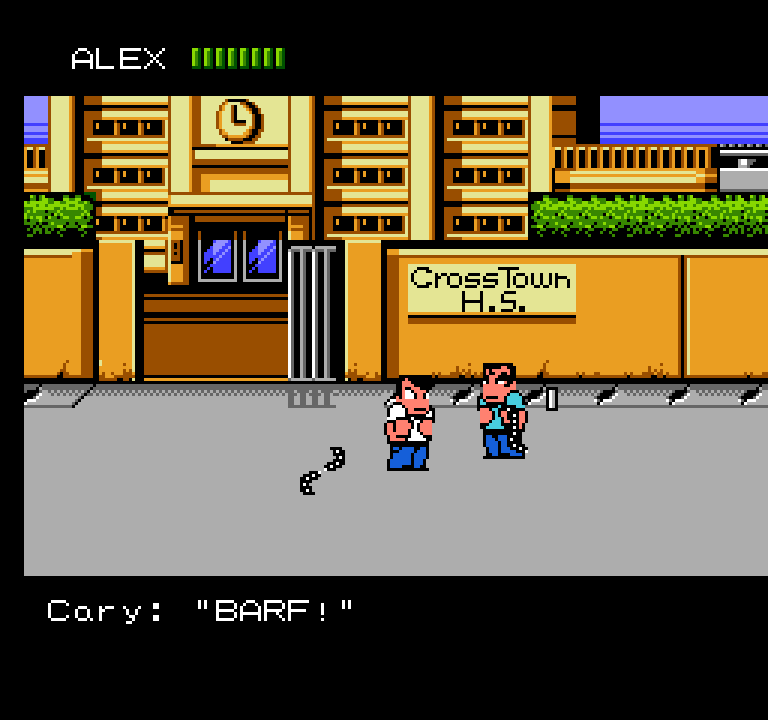
It deserved the success. While the original Kunio game set many of the beat-em-up genre standards, River City Ransom blends that genre with the roleplaying game (RPG) genre, giving players a more open world to explore and letting them build up their characters' abilities by buying food and other items at malls, using money they earn from defeating enemies. As was standard for Kunio games, the localization changed the characters' appearances and names; such as Kunio being renamed Alex and Riki being renamed Ryan. Though this series had been ancestral to most subsequent beat-em-ups, River City Ransom had still found an identity apart from them, ensuring that it, along with its chibi sprites and silly tone, remained the series' standard.
The most famous of several memes the game spawned.
Except when they weren't. From time to time the series' original creator Yoshihisa Kishimoto stepped back in to lead new Kunio projects, often with more realistically-proportioned characters and generally with more serious stories. This reached its peak on Super Famicom's Shin Nekketsu Kouha: Kunio Tachi no Banka, a gritty and mature game wherein Kunio is framed for a murder, and thus must break out of jail and clear his name with his friend Riki, his girlfriend Misako, and Riki's girlfriend Kyouko5. Contrary to popular belief, this is not the first game where Misako appeared (that was Nekketsu High School Dodgeball Club: Soccer Story), but it is the first game where she is playable, and it is Kyouko's first appearance...and also her last, for 19 years. The game's plot is not exactly deep, but it's very serious, containing a moment where the villain shoots the girls; traumatizing everyone and prompting Kunio and Riki to go forth and take him down and once and for all. Misako and Kyouko survive, but that is not revealed until the end. The game was never released in the west at the time, and as Technos would go bankrupt soon after, it remained relatively obscure until recently, as would the Kunio Kun series.
Talk about mood whiplash!
Some time after Technos's closure, people who had worked on it regrouped and acquired the license. Production and release initially mirrored the direction they had taken in the Technos era; namely in that most games wouldn't get released outside Japan and those that did got localized in a variety of different ways. As it had already been localized before, Down Nekketsu Monogotari would be released stateside as River City Ransom EX, with the same localized names from the original American release despite graphics not being changed for this one. The next Kunio game to be released in the USA was Chō Nekketsu Kōkō Kunio kun Dojjibōru Bu, or as it became known in the western release, Super Dodgeball Brawlers. This is of note for actually keeping all of the Japanese names in the English version.6
Then in 2010, everything changed. Kunio-kun no Chou Nekketsu! Daiundoukai was released in the west as River City Super Sports Challenge, with the Japanese names intact, and this would be the standard for all Japanese-developed Kunio games since. Since then, River City has been the series' official western name, which means more than ever before, most people saw this series through the silly, cartoony, meme-filled lens of River City Ransom.
Thus the River City Girls Were Born!
Thus it was the case with me. I learned of this series by reading about the original NES RCR, then entered it with the GBA remake of that game and discovered the rest of the series online. That was also the case with Wayforward's Adam Tierney. He came to this series with a sense of levity, and as such. when he discovered Kunio Tachi no Banka, as he has recounted many times, his main takeaway from that overall dark game was his amusement at seeing rather diminutive girls taking down much larger opponents. He proposed to the current Kunio license holder, ARC System Works, that he would like to make a new game starring these girls, and they greenlit the project.
The resulting game, the first River City Girls, certainly deserves that name. It was probably inevitable that it would get a name starting with "River City", but while Adam Tierney was inspired to make it by playing Kunio Tachi no Banka,and it's the first Kunio game in a long time not to use a chibi art style, River City Girls mostly resembles River City Ransom in not only its humor, but also its RPG gameplay mechanics and more open-world structure. Though its plot is wrecked by the fourth wall humor in its secret ending and some of the things shown earlier aren't fully explained, it generally functions as a self-contained story with a consistent humorous tone. However, it's popularity has prompted Wayforward to push for both a sequel and a port of the game that inspired it, and this is going to highlight just how very, very different in tone they really are. In fact, they're not only different in tone, but as ShaggyTurtleStudios puts it, probably in different universes.
Though this is not outright stated, it seems rather necessary when what things can and can't happen in a game, and how they're regarded by people within that game, are so different. In Kunio Tachi no Banka, being shot by a handgun requires Misako and Kyouko to be hospitalized, and Kunio and Riki fear they will die, and regard death as permanent. Worth mentioning is that in that game, each character has his or her own separate life bar, but if anyone's life bar drains to zero, the game is over for everyone, so the player, too, has to treat death as a big deal. By contrast, in River City Girls, Misako and Kyouko fall off a tall building, rather nonchalantly plan on how to land gracefully, and after crashing through a roof, just remark that they'll be sore in the morning. If a protagonist in River City Girls is killed, represented by the Super Dodgeball ball angel rising out of his or her body, that character's ally can assist by stomping on his or her corpse to revive him or her, and even if that fails, simply entering a new room will also revive the ally. The plot of Kunio Tachi no Banka has Kunio thrown in jail because people believe he killed someone by running her over with a motorcycle. In River City Super Sports Challenge, Kunio can push an opponent into the path of a train as a way of beating that opponent in a foot race, and nobody cares! Though these games have the same characters and the same names between them, at least before localization, some of their worlds have quite different physical rules from one another and as such, their characters have different expectations.
Oh Man; Another Tangent?!
Think of it like Batman. Almost everyone can recognize Batman, even if they don't know him well. There are some standards, like Batman's costume having bat ears and him using gadgets. But Batman stories are also set in multiple different universes where things work very differently from one another. Very few people would suspect that these two videos are set in the same universe.
And in fact, they're not. DC Comics' policy officially recognizes that there are many different versions of their universe with different versions of the characters within them. The same is true of Marvel, a factor that has become well-enough known that it was used as the premise of the movie, Spider-Man: Into the Spider-Verse. Characters from one universe can visit another, and it can be very entertaining, but it's important to their policy to emphasize their differences.
By contrast, Wayforward,in re-branding Kunio Tachi no Banka as River City Girls Zero, feels like it's acting like those differences don'texist between Kunio games7. This has the potential to put their writers in a bind, because having some clear rules that govern what happens in a fictional universe helps determine how characters ought to act and also the sort of stories one can tell in them.
Consider, for example, the necessary differences in how a cliff would be treated in a James Bond film vs a Roadrunner and Coyote cartoon. In a Bond film, anyone who falls off the cliff will die, graphically in some, and thus if James Bond fights someone near a cliff, the fight is suspenseful; each time someone is pushed close to the cliff's edge, we know it could be the end of that person. By contrast, in a Roadrunner and Coyote cartoon, a fall off a cliff will not kill a character. That character (usually Coyote) will certainly be hurt by the fall, and there may be a graphic depiction of sorts; maybe the character's body will be squashed into itself like an accordion, or maybe the character will make a hole in the ground shaped like his body, but they won't go the realistic route and kill the character in bloody explosion, which means that not only can a fall off a cliff be played for comedic effect, but it need not even be the end of the story. No matter how much pain we see Coyote (or any other of the many cartoon characters who fall off cliffs) in, the show can move on to another scene wherein the character is all healed and ready for another fight, much like the players you could murder with your super dodgeball in the Kunio dodgeball games. But such a cartoony approach to physics and biology isn't exactly a blank check to write whatever you want, as once you establish that such a fall is relatively inconsequential, if you even try to create suspense by making Roadrunner and Coyote have an epic battle at the edge of a cliff, you won't succeed. Audiences no longer have any reason to expect this to be a make-or-break moment for a character, so they won't8.
There is cause for concern there, but above all, curiosity. It's probably fair to mention that I don't have a particular preference for a game being lighter or darker; the key question is how to juggle the two. Based on the statement there, it sounds like it may be a similar situation to the Marvel Cinematic Universe's Avengers movies. In those, the world is under huge threats, and the heroes have arrived to stop them, but they still manage to bring the quips and do a lot of good-natured bonding in the process. Possibly reaffirming this theory is that Wayforward earlier announced that River City Girls 2 would feature "the return of an old foe". That is a plot formula I really like, but it's still prudent to consider what contributes well to such a story, and what detracts. There are, of course, multiple factors, but they all feed into one point that I think is of the utmost importance: I have to like the protagonists. Moreover, this admiration has to extend all the way through the story and I must feel rewarded for liking them. Fortunately, as I will explain, I think we're on the right track.
Here I must highlight what the first River City Girls did well, but also what it did not. The beginning of the game I once found so iffy (that is, the part of it up until the first boss), I no longer have as much issue with, and this is because I played the whole game and saw its full characterization of Misako and Kyouko so far. Contrary to what I expected, Misako is not just a shallow, violent grump, but rather a pragmatic adventurer who has long been willing to defend her friend, Kyouko against bullies. Kyouko might still be a bit too stupid at times, but in this case "too stupid" means "stupid enough in some scenes that it's hard to believe her more competent behavior in others, which is a problem in many cartoon comedies, and though I'd prefer her stupider moments weren't there, her better bits in the game are very lovable. Even Kunio gets a small but likable bit of characterization in a cutscene before fighting Yamada. However, then there's those endings, which as ShaggyTurtleStudios put it, make everyone seem like a bad person, even though we heard a lot of dialogue and saw manga cutscenes up until that point that made them seem like good ones--also, actually showed the girls being in a relationship with Kunio and Riki.
What was going on? Was it all just a hallucination? Wayforward hasn't really answered, so we were left with the unpleasant feeling of characters we loved--some we loved even before this game brought them all new levels of recognition--being ruined, at least as viable heroes. We got that now infamous real-world explanation of why Wayforward wrote in that twist ending, but in-universe, what all happened? How much does each character remember? From which games? How much of what they remember is even real? Was it all just a dream? We don't know. When asked about it, Adam Tierney has said it's best left up to player interpretation.
In terms of sequel potential, though, of course it can't be. It's hard to tell if at the time of writing their original game's story, they knew that it would become incredibly popular and warrant making a sequel, but it did, and they're making a sequel. While we still know very little about it, the most exciting thing about this, for many fans who weren't amused at the original's twist ending, is that it almost demands Wayforward explains just what was going on in the original, and also to salvage its four playable characters as likable people who have other motivations besides just shallow lust. It's nearly impossible to do the same twist ending twice, the game will have additional playable characters, and each of the characters will have unique dialogue, so this time around, Misako and Kyouko have to be motivated by something other than rescuing Kunio and Riki from a threat that didn't exist. This time, it's nearly certain that there's a real threat. That is good. Also, River City Girls being as popular as it is means that regardless of what mixed messages it actually sent, most players in most of the world will think of its protagonists as canon couples.
The above describe all of the factors entailed in simply making a sequel to River City Girls, but there are additional ones added by Wayforward's decision to localize Kunio Tachi no Banka as River City Girls Zero and tie the three games' plots together.
History is the Key to the Future (Though Not to a Good Job)
First, giving the game wider exposure to people outside Japan makes it harder to trivialize. ShaggyTurtleStudios and Flodo_McFloodiloo both accurately assessed the issue with how the events of that game are regarded in River City Girls, at least by seemingly everyone other than Misako and Kyouko. What should have been traumatic and emotionally bonding events were discounted because they took place in just one game that was obscure outside of Japan and 25 years old at the time River City Girls was released, and players who weren't really aware of that game might have had an easier time laughing at the implication that Misako and Kyouko were just delusional stalkers who couldn't move on. Likewise, they have no reason to be upset that Kunio and Riki act like jerks, at least in the game's "bad ending". The video from Roger Van Der Weide that I linked in my last River City Girls post also had some nice insight into dark comedy. It needs extra context to work, and a common way to make unjust scenarios look funny is by detachment; that is, removing the humanity of emotion of characters so they can only be the butt of jokes. "However, we only laugh when we're detached. We don't want to see the guy who comically fell on his face on YouTube to be actually dying in a hospital bed." Having no personal memory of the game with serious scenarios and these characters being genuinely heroic, assists in such detachment.
However, by re-releasing Kunio Tachi no Banka and declaring that it is the predecessor to River City Girls, they are effectively signaling that the actual events of that game do matter. It's no longer old, it's no longer all-but unknown in the USA, and when it's brought back specifically to be the backstory of the River City Girls series, characters in that series can't ignore its events any longer. If they do, they'll annoy many players who, thanks to now having that game fresh in their minds, can't ignore them either.
Second, as jarring as it is how different the two games are in tone, I feel reminding everyone of Kunio Tachi no Banka helps give these protagonists a sort of moral anchor. I brought up Batman above as a better-known example of a brand that can go all sorts of stories in all sorts of universes with all sorts of tones. It can be very serious, or it can be very silly. But there are some things one can only take so far. The reason many people can enjoy all of these Batman media is because they're willing to follow Batman himself through them. He's been established as a character people admire and relate to, and to make them like the ride, some things about Batman, such as his motives, have to stay intact. His behavior in the moment has to reflect those motives, or at least, not contradict them. The big constant of having witnessed his parents being murdered in an alley making Batman dedicate his life and resources to fighting crime must be intact and it must matter. If Batman falls short of how he should act based on that past, audiences expect him to right himself by the story's end.
This is why All-Star Batman and Robin was so widely despised but The LEGO Batman Movie was generally well-received. Watching Batman do a lot of odd things can be very amusing, because many of those don't go against his origin as traumatized child, but if Batman ever starts tormenting children it's going to feel very wrong. Maybe not impossible to laugh at, but as Roger said, this sort of laughter would come at the expense of telling a proper story with Batman. There may be more debate on just how far Batman should become obsessed with a past-dictated moral code, but I think my point on this much is clear.
There's little doubt that these characters aren't like Batman, but if you play at least their fighting games that have a story beyond "there's a tournament", then it's still obvious that they're characters. In River City Girls Kunio and Riki barely function as characters because they're mostly just an objective, but inviting that games' players to play a game with those characters in a serious narrative sets them up to understand them as people. They're not deep; they're rough and hedonistic, but they're also dedicated friends who won't stand for the strong exploiting the meek. Misako and Kyouko, admittedly, didn't have as much personality in Kunio Tachi no Banka, beyond just being girlfriends,but that still puts them in a different context when they all have to save the day. There's something endearing about the concept of people you wouldn't normally think of as hero material being forced into a corner together and going up against a truly evil force, and once people have tasted that, they may well want to taste it again.
Conclusion (What Took You So Long?!)
Now, all of the above does not absolutely guarantee that Wayforward will stick this landing. They might still screw the plot of River City Girls 2 up. They might even make some changes to Kunio Tachi no Banka that ruin a lot of it, and if they do that, then the plot of River City Girls 2 may feel dead on arrival. However, it's not like the plot of the first River City Girls is a constant deluge of bad writing; it was, I probably wouldn't have kept playing it. So making a better plot doesn't really demand the writers get better at their job, so much as notice what bits were really odious in the original and not do anything like that here.
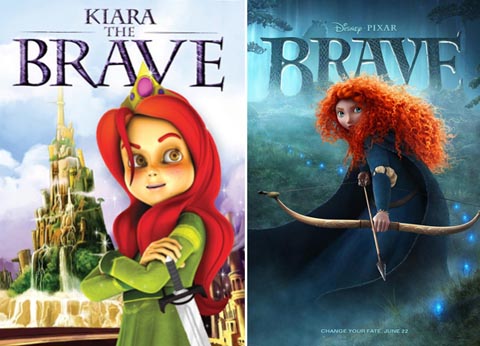
Note: Don't watch that movie on the left, regardless of what it is currently titled.
However, at least Wayforward is being completely honest about what they're doing. And the game is more enjoyable than Super K.
So for now, I patiently await their attempts at establishing a good narrative. I hope I get one, but if I don't, at least I should be able to make one Hell of a blog post about it! It might even be longer than this one!
Notes:
1. The game always had two final bosses, one of which could only be fought using an item unlocked after beating the other, and the bosses had unique conversations, but initially the manga cutscenes that played after the bosses were exactly the same. A patch eventually was made that changed the cutscene to a happier ending if you choose to fight the secret boss.
2. In other words, the rather common dynamic of a cheerful but more naive character paired with a grouchy but more insightful character.
3. You may note that their relationship seeming built on little more than shallow lust was also a big issue I cited about the demo. While the ensuing game did give the heroines more positive traits and made them likable characters, that problem with them was quite revived in the game's endings.
4. "Chibi" is a common Japanese term for character designs that look "boxed in and have disproportionately large heads compared to their bodies; Hello Kitty being perhaps the best known example.
5. This is not an easy name to romanize. Some Japanese words have vowel-sounds prolonged and while Japanese spelling conventions are generally much more consistent than English ones, a rare exception is prolonged "o" sounds; they are spelled by adding a u after the o, but pronounced as simply an o held longer. Thus with this name, I spell it "Kyouko", which is also how the fan-translation of Kunio Tachi no Banka spelled it; however, River City Girls did not attempt to maintain the prolonged vowel so both spells and pronounce it "Kyoko".
6. However, this was not the first Kunio game ever to do so; that was the Neo-Geo Super Dodgeball game.
7. Notice how in the linked Silicon Era article, the upcoming titles are immediately referred to as "two new games in the River City Girls universe", though to be fair that may just be how that article's writer interprets it and not Wayforward's actual stance.
8. This, too, may remind you of the sentiments I expressed in that post I did based on this game's demo. As with character personalities, warping reality for the sake of delivering a joke can be very effective, but it makes it harder to tell meaningful stories that appeal to other emotions. I plan to return to this theme in a later post, wherein I do a SpongeBob Squarepants retrospective.
A note before going into detail about this game: I am up to Chapter 10 in its Story Mode, have completed just one "Event" so far, and haven't obtained anywhere close to all the characters, so the opinions expressed here are to some degree tentative. Nevertheless, I feel I have spent enough time with this game that I can now say a lot about what I do and don't like about it. Onto the details.
Hey; how did you know I wore a ring?! Or were you talking about yours?
Foreward
In case you haven't heard, Pokemon Masters is a mobile platform spin-off of the Pokemon series, and while it keeps the collecting aspect of the core series, this time each Pokemon obtained has a human trainer to go with it; trainers brought back from all previous generations of Pokemon thus far. In fact, these human trainers are what you collect directly, their (under most circumstances) one-Pokemon-each forming what is known as a "sync pair" with them, and them all having gathered on the Island of Pasio to compete in a special tournament called the Pokemon Masters League, and their dialogue and interactions with each other and the player occupy a lot of the story now. This new focus on a previously underrepresented aspect of the Pokemon series proves to be double-edged; displaying some admirable creativity and passion, but with frequent reminders that this isn't what the series was designed to do.
Story Time
I've read it said in multiple other places that this game has good writing. By the standards set by other Pokemon games, that's a fair assessment. Characters speak in ways that fit their archetypes, occasionally their dialogue is relatable, and on some rare occasions it can be funny. However, the problem is that this still is a Pokemon game, so not much is really going on in it to foster stimulating conversation. The vast majority of what everyone talks about is Pokemon, a fair amount of talk about Pokemon is about them battling, and a fair amount of that Pokemon battle talk is about battling in the Pokemon Masters League tournament, which in typical Pokemon fashion takes center stage even though there's also a rival and an evil team to take on.
Well this sounds exciting! Except that fight never happens.
Yes; such shallow plot, characterization and dialogue are typical of Pokemon games, and that wasn't a big deal in games where plot, characterization and dialogue weren't the big draw anyway, but in this game they are, and having to wade through so much more of the same gets tiresome fast. There are some dialogue trees in the process, but no choice really makes any difference besides sometimes getting a different response.
There's no greater testament to how much this game's banking on character appeal and dialogue than the "Sync Pair Stories". These side missions, of which each sync pair has at least one, mostly have no actual gameplay; merely many lines of dialogue to read through or pretend you're reading through as you keep tapping the screen. They aren't what I'd call optional, as they grant you extra gems that can be used for the game's "GachaPon" system, which both unlocks new characters and can help power up characters you already own. (More on that later)
For a game whose appeal is supposed to be its characters, it doesn't focus nearly enough on making its characters appealing. One of the most immediately noticeable missteps of the game's story is that while the first two allies it grants the player are Brock and Misty, presumably due to them being Ash's traveling companions in the first three seasons of the anime, their personalities here bear no resemblance to those of their anime counterparts. Granted, the anime is divisive even among Pokemon fans, with some opining that it makes the whole franchise look too childish, but since these characters are obviously there for people who do like the anime, lacking parity just makes them feel hollow. Brock being constantly lovestruck and Misty having a hot temper may not be the deepest character traits and their appeal is subjective, but at least they're something. Brock and Misty in this game don't have much of anything to their personalities.
Also noticeable is that the graphics and voice acting don't do a very thorough job of bringing these characters to life. In still photos, Pokemon Masters looks quite good; while I wish most characters weren't so skinny and it seems like their upper bodies are a bit too small compared to their lower bodies, the vibrant colors and cell-shading give it an appropriately animesque look that's easy on the eyes. In motion, though, this game can stumble into the uncanny valley, with animations that seem poorly utilized or at times outright unfinished. Cutscenes progress as you click through lines of dialogue, and while the game is waiting for you to move on, characters might freeze in an awkward pose, or cycle repeatedly through an animation that seems like it's only supposed to be played once and then stop at the end.
Misty's mouth is not moving during that caption; it is just frozen in that open pose.
Then there are moments where dialogue text refers to things happening which clearly aren't, such as Korrina saying to watch her do her rolling axe kick and not doing it, or Blaine telling Flannery to get back up when she's already standing. Voice acting, meanwhile, is constantly like that, with every character's voice being limited to an introduction speech and a few catchphrases. Those catchphrases do well enough to add personality to battles, but they're spruced into text dialogue that is saying different things; sometimes very different.
So in short, a good rule of thumb for game narratives
should be that their quality should increase with their presence, and
this one's quality has increased, but not nearly as much as its presence
has. If only they let people talk about something other than Pokemon, even things that seem as mundane as taxes, vacuum cleaning and hiphop, they might manage to give people comparable appeal to Pokemon. But still, at least it has the things the Pokemon games are good at to fall back on, right? Somewhat.
Enough Talk; Let's Fight!
Combat in the traditional Pokemon games is turn-based, usually one-on-one, occasionally two-on-two, or very rarely three-on-three, utilizing four moves per-Pokemon, each with a limited number of uses, and an expanded "Rock Paper Scissors" system of strengths and weaknesses to the Pokemon and their moves. This game's battle system bears an obvious resemblance to those, but almost everything has been altered to some degree. Combat is now in real-time, the four-moves of every sync pair are split between the trainer's moves (most of which affect status) and the Pokemon's moves (most of which damage other Pokemon), and each sync pair only has one strength and weakness compared to others. Often, they're based on how the Pokemon's type worked in the core series, but with only one power relationship in each direction allowed, it can only go so far. Finally, while the trainers' moves still have a limited number of total uses, Pokemon moves have switched to using up stores of an energy meter that gradually recharges. (Generally the better the move, the more energy it costs.) Finally, bit by bit super attacks called "Sync Moves" charge up, which can make a big difference between victory and defeat.
All of the pros and cons surrounding basically every move lend the combat in Pokemon Masters far more depth than you'd expect from a free-to-play game on a non-game-focused platform; possibly even enough to garner the affection of fans of the core Pokemon titles, despite the reduced use of type effectiveness. In stark contrast to the narrative portions of the game, you can't just click through battles and expect to win unless you're a much higher level than the opponent; you constantly have to think. (You can set an AI to fight battles for you, but it's not very smart.) That's good.
However, some of the limitations placed on moves slow things down far more than they should in a real-time combat game, and worse still, keep the team mechanics from reaching their full potential much of the time. The aforementioned energy meter is unrealistically shared by all three Pokemon on a team, and while sometimes being unrealistic can lead to better gameplay, it really doesn't here. If a Pokemon's attacks have an advantage over an opponent (and it's easy to adjust your team so that they will), the best strategy is usually to fire off these super-effective attacks (or just one, repeatedly) as quickly as possible, hogging up most if not all of the energy bar. As a result, in most matches I have fought, there's at least one Pokemon that I don't use for anything besides an extra target for opponents to hopefully attack instead of my more effective Pokemon--and in some matches, two Pokemon might be ignored in kind.
Come on, refill! Cross Poison! Cross Poison!
Another place where unrealistic mechanics bog the gameplay down is the relationship between Pokemon and their trainers. They're obviously separate entities, but if you choose to use a trainer move (which again, don't affect the energy meter), somehow that trainer's Pokemon's moves become unavailable to use for a time. Probably a brief time, but when you have two other Pokemon who aren't disabled that's just one more thing that will lead to some Pokemon doing almost nothing. Conversely, while the trainers aren't attacked directly in fights, if their Pokemon faint that makes the trainers' moves unusable, too. What can I say, when a big part of a game's premise is that a party of three is fighting in tandem and a third of that party is often nearly useless, something has gone wrong, and play-testing should have made them see that and fix it.
The Story Mode of Pokémon Masters is almost completely linear, with scant room for emergence. In occasional sections you'll be allowed to navigate a bit around a map by clicking on arrows, looking for (poorly hidden) items and talking to people, but the majority of Story Mode is you moving where the plot says, meeting whom the plot says, talking and fighting with whom the plot says, in the order the plot says. Even though you can change who's on your team between every sub-chapter, that has no bearing on which characters feature in the cutscenes. As addressed in last section, the story that gives this mode its name isn't exactly worth the price of admission, and then at some point, difficulty shoots up, forcing grinding, and engagement with that plot plummets even further.
Let's Keep Fighting!
Pokémon Masters has been praised for how limited its microtransactions are, with the only things costing real money being the gems used for the trainer gacha machine--and note that the Story Mode will unlock a lot of sync pairs, and that there are many in-game ways to get the gems. That is indeed nice, especially in a franchise aimed at children, but it seems like the game was designed to feature a lot more microtransactions that were dropped before release. I say this because much as in Teenage Mutant Ninja Turtles Legends and probably other freemium mobile games, the new, stronger opponents in later chapters will force you to battle weaker opponents to level up, and it seems purposefully inefficient. Leveling up seems straightforward at first; just fight and gain experience, but it soon becomes apparent just how much more complicated it is. Sync pairs have maximum level caps that you must pay other items to raise, and furthermore, leveling up does not unlock new moves the way it does in the core series; these, too, require items to buy. Finally, there are items that can be spent to level up characters in the same way as experience was. The fastest way to earn all of these items is to visit a designated training area, but it's still not very fast. It's a mess of collectable trinkets that seems to be there just to annoy people into paying their way through it, except they can't.
Of course, grinding (that is, fighting weaker enemies to power up gradually) is common in the core Pokémon RPGs, too. There are likely few RPGs where it isn't. However, in the past it felt better incorporated into the adventure. Can't beat this gym leader? Then take a hike to the outskirts of the town, explore tall grass, and get in fights with Pokémon to power up, and then come back into town. It's wasn't great worldbuilding, but it still lent some sense of a consistent story. In Pokémon Masters, a game with almost no independent movement, you just open a menu and select what you want to do; continue the Story Mode, whose battles are tied together by cutscenes and dialog, or spend some time in Training Mode, whose battles aren't. This game breaks with freemium convention by having no energy system to limit how much you can fight these battles before having to either wait or pay for a refill; you are free to play this game for as long as you like, earning what you can. [NOTE: That has changed since I wrote this article] But would you really want to? Your reward for playing this game more is getting to play it more, and playing it just isn't that satisfying.
Conclusion
This review has been almost entirely criticism, so to clear the air up, the game is not terrible. Its actual combat has a commendable amount of depth for a mobile game, and on occasion its dialogue is appealing. Everything in this game is, at worst, okay. It doesn't often rise much higher, though, and the thing about things that are just okay is that when they're constantly crammed down one's throat, particularly the same few just-okay things repeatedly, they start to feel much worse than just okay. Among mobile freemium RPGs, you can certainly do worse, but among Pokémon RPGs you can certainly do better. DeNA seems to have missed the point of making a Pokémon game. They focused on the things that the Pokémon series hasn't traditionally been good at without changing them enough, while throwing out many things that the series has been good at and changing those few good things it left in too much. However, I still support a character-focused Pokémon game in theory, and I hope this game can eventually grow into its self-appointed shoes with new events. For the moment, though, while this isn't the worst mobile game I've played by a long shot, it is easily one of the most disappointing.